The 2015 Meat Labeling Law: What Changed for Beef and Pork?
Imagine walking through your local grocery store.
You pick up two packages of beef.
Both were packaged in the United States.
Both carry USDA inspection marks.
One may have come from cattle born, raised, and harvested in America.
The other may have come from cattle born and raised in another country before being processed in the United States.
Can you easily tell the difference?
In many cases, the answer is no.
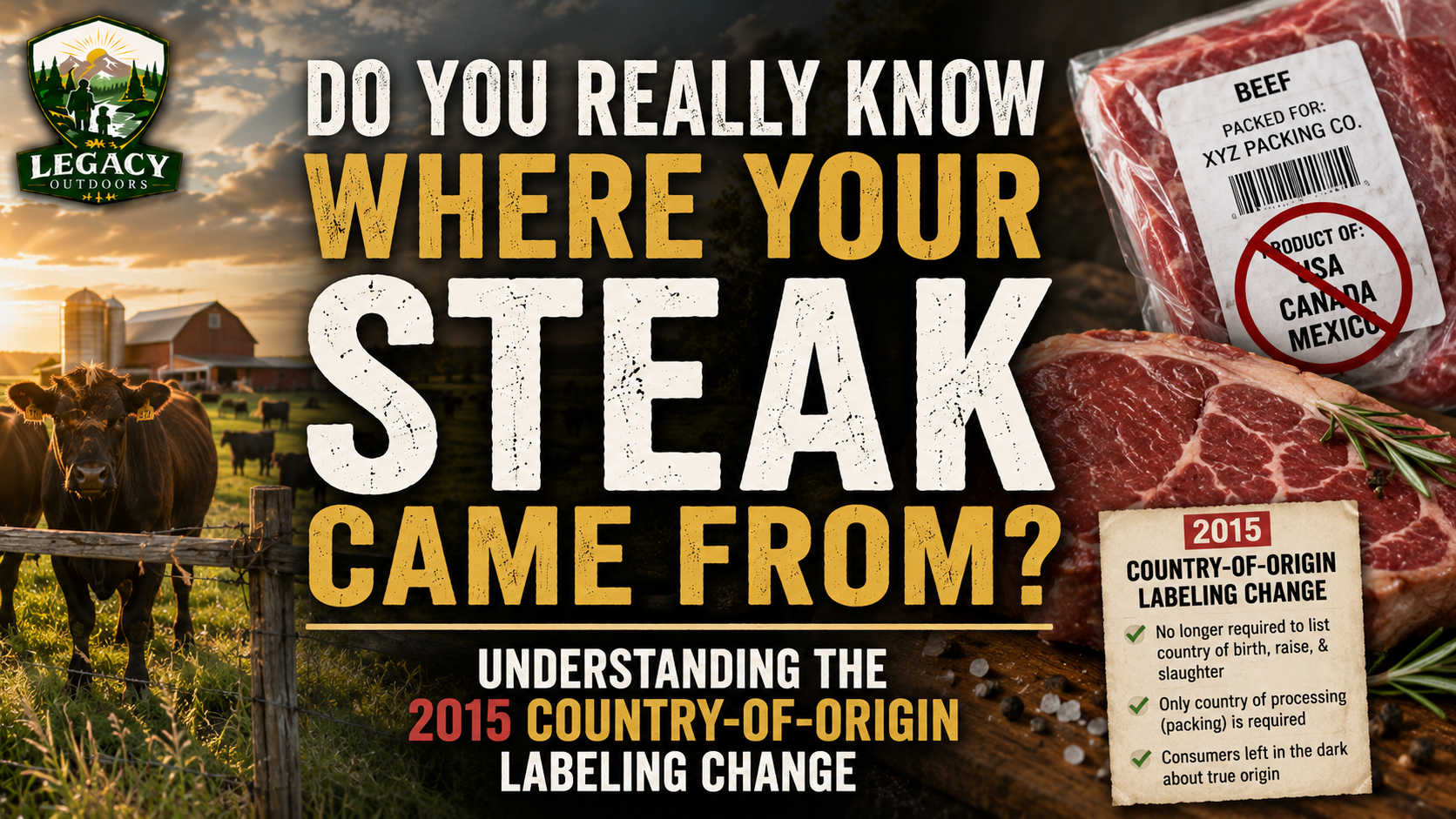
That’s because one of the most significant changes to meat labeling in recent history occurred in 2015, when Congress repealed mandatory Country of Origin Labeling (COOL) requirements for beef and pork.
For consumers who care about supporting American ranchers and knowing where their food comes from, it’s a change worth understanding.
What Was Country of Origin Labeling?
Country of Origin Labeling—commonly called COOL—required retailers to disclose where certain food products originated.
For beef and pork, labels identified where an animal was:
Born
Raised
Slaughtered
This gave consumers additional information when deciding what products to purchase.
Mandatory COOL requirements remain in place today for several other products, including chicken, lamb, goat, fresh fruits and vegetables, peanuts, pecans, ginseng, macadamia nuts, and both wild-caught and farm-raised fish and shellfish. Beef and pork, however, are no longer covered by the mandatory retail-origin labeling law.
Why Was the Law Repealed?
The repeal was not primarily driven by food safety concerns.
Instead, it stemmed from a lengthy international trade dispute.
Canada and Mexico challenged the U.S. labeling law before the World Trade Organization (WTO), arguing that the requirements discriminated against imported livestock. After several rulings against the United States, the WTO authorized Canada and Mexico to impose more than $1 billion in retaliatory tariffs if Congress did not act.
In December 2015, Congress included the repeal of mandatory COOL requirements for muscle cuts and ground beef and pork in the Consolidated Appropriations Act. President Barack Obama signed the bill into law, and the USDA immediately stopped enforcing those labeling requirements before formally updating its regulations in 2016.
What Does That Mean for Consumers Today?
One of the biggest misconceptions is that every package of beef clearly tells you where the animal was raised.
That is no longer generally true for beef and pork sold at retail.
Consumers may still see processing information, inspection marks, or voluntary marketing claims, but mandatory retail labels identifying where the animal was born, raised, and slaughtered are no longer required for those products.
This distinction matters because the location where meat is processed is not necessarily the same as where the animal spent its life.
Why Ranchers Continue the Debate
Since the repeal, many cattle producers, consumer groups, and some lawmakers have continued advocating for the return of mandatory country-of-origin labeling for beef.
Supporters argue that consumers deserve transparent information and that American ranchers should be able to distinguish their products from imported beef.
Opponents generally contend that reinstating mandatory labeling could increase costs, complicate international trade, and risk renewed trade disputes with key partners.
The discussion has remained active in Congress, with various proposals introduced over the years to restore mandatory labeling in some form.
How Can Consumers Support American Agriculture?
Regardless of where someone stands on the labeling debate, there are practical ways to become more informed about food purchases.
Many families choose to:
Purchase beef directly from local cattle ranchers.
Buy freezer beef from nearby farms.
Shop at local farmers markets.
Ask their butcher where the meat originated.
Look for verified labeling programs when available.
Support companies that emphasize sourcing from American farms and ranches.
Building relationships with local producers often provides a level of transparency that grocery store packaging alone cannot.
Why This Matters Beyond the Grocery Store
For many outdoorsmen, this issue is about more than labels.
Hunters understand where their venison comes from because they harvested it.
Anglers know where their fish came from because they caught it.
Gardeners know where their vegetables came from because they planted them.
Many consumers simply want the same level of transparency when purchasing beef and pork.
Knowing where food originates allows families to make purchasing decisions that align with their priorities, whether those priorities involve supporting local agriculture, buying American-raised products, or simply having more information.
A Legacy of Knowing Your Food
For generations, Americans bought meat from local butchers who often knew the ranchers personally.
Today’s food system is much larger and more complex, but many families are rediscovering the value of understanding where their food comes from.
Whether that means harvesting your own venison, catching fish for dinner, planting a backyard garden, or purchasing beef directly from a trusted rancher, one principle remains the same:
The more connected we are to our food, the more we appreciate the people and the land that provide it.
For many outdoorsmen, that’s not just a matter of preference.
It’s part of preserving a legacy of stewardship, self-reliance, and support for the hardworking farmers and ranchers who continue to feed America.
Free. Delivered to your inbox.